This guide provides general information about Ohio child safety seat law and NHTSA guidance. It is not legal advice. For specific legal questions, consult Ohio’s official child restraint law at codes.ohio.gov and the National Highway Traffic Safety Administration at nhtsa.gov.
Xpress Elite Chauffeurs | Columbus, Ohio | By Xpress Elite Chauffeurs — Columbus Child-Safe Transportation Specialists
Key Takeaways
• Most limo services do not provide car seats — parents and guardians must bring their own and install it in the vehicle.
• Ohio law (ORC 4511.81) requires child safety seats for children under 4 years or under 40 pounds in all passenger vehicles, including hired cars and limos.
• NHTSA recommends keeping children rear-facing as long as possible until they reach the seat’s height and weight limits.
• Children aged 4 to 7 and under 4’9″ tall require a booster seat in Ohio. Children 8 and older or over 4’9″ require a seat belt.
• All children under 13 should ride in the back seat — front seat air bags pose a serious injury risk to child passengers.
• Car crashes are the leading cause of death for children — proper car seat installation and correct seat belt fit save lives.
• Contact us before booking if you are traveling with child passengers — we accommodate car seat installation and confirm the right vehicle for your group.
Introduction
Do limo services provide car seats? The direct answer is no — most limo services, black car services, and chauffeur companies do not supply child safety seats. Ohio law requires child restraints in all passenger vehicles, including hired cars and limousines. The responsibility for bringing, installing, and correctly using a car seat rests with the parent or guardian, not the vehicle operator.
This guide covers Ohio’s child passenger safety laws, the correct car seat for each stage of a child’s development, how to install a seat in a hired vehicle, and what to confirm when booking a limo or car service in Columbus, Ohio with child passengers on board.
Ohio Child Safety Seat Law: What the Law Requires
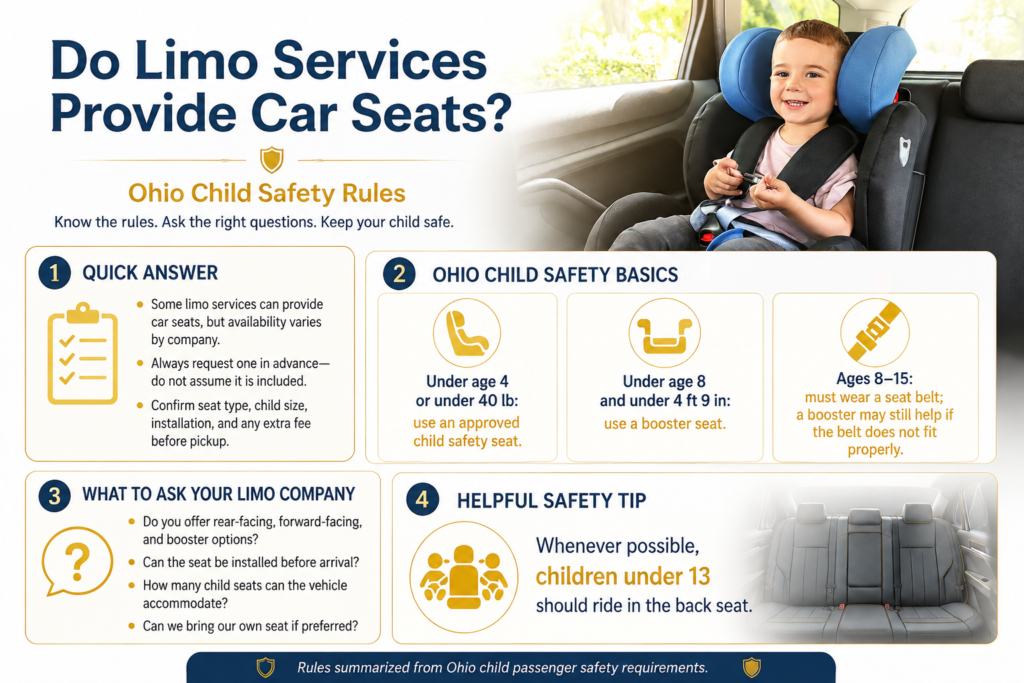
Ohio’s child restraint law is governed by Ohio Revised Code Section 4511.81. The law applies to all motor vehicle operators in Ohio and all seat passengers — including those in hired vehicles such as limousines, black car services, and car services. The parent or guardian traveling with the child is responsible for ensuring the child is correctly restrained in the appropriate child safety seat or seat belt for their age, height, and weight.
| Child’s age / size | Required restraint | Ohio law basis | NHTSA guidance |
| Under 4 years OR under 40 lbs | Child safety seat (rear or forward facing) | ORC 4511.81 | Rear-facing as long as possible |
| 4 to 7 years AND under 4’9″ | Booster seat with seat belt | ORC 4511.81 | High-back booster recommended |
| 8+ years OR 4’9″+ tall | Seat belt (lap and shoulder belt) | ORC 4511.81 | Back seat until at least 13 |
| All children under 13 | Back seat strongly recommended | NHTSA guidance | Front seat air bags pose risk |
Ohio law specifies the minimum requirements. The National Highway Traffic Safety Administration — part of the federal highway traffic safety administration — recommends exceeding the legal minimum wherever possible. Specifically, NHTSA recommends keeping children rear-facing as long as possible, even beyond 2 years old, until they reach the rear facing car seat’s height and weight limits.
All children should ride in the back seat until at least 13 years old. Air bags in the front seat are designed for adults and can cause serious injury or death to child passengers, particularly those in rear facing car seats positioned in the front. The vehicle door and side air bags also present a risk for small children in booster seats seated too close to the door. The back seat eliminates these risks.
Do Limo Services Provide Car Seats?
The straightforward answer is that most limo services, chauffeur companies, and black car services do not stock or provide child safety seats. There are several reasons for this. Car seats are designed for a specific child — the correct seat depends on the child’s age, height, weight, and the vehicle’s seat belt configuration. A seat that installs correctly in one vehicle may not install correctly in another. The safest car seat is the one that fits the child and vehicle and installs correctly every time.
Providing a car seat that a parent has not inspected, verified, and installed themselves introduces liability and safety risk that responsible operators do not accept. Car seats have expiration dates — typically 6 to 10 years from the manufacture date — and a seat supplied by a third party may be expired, damaged from a prior minor crash, or incompatible with the vehicle’s latch system. Child passenger safety experts consistently advise that parents bring their own seat, install it themselves, and verify the installation before the child rides.
Never use a car seat that has been in a previous car crash, is past its expiration date, is missing parts, or did not come with its original instructions. Always bring your own car seat when booking a hired vehicle with child passengers.
What Xpress Elite Chauffeurs Does
We do not supply car seats — consistent with the advice of child passenger safety experts and Ohio law requirements that place installation responsibility with the parent or guardian. What we do provide: vehicles with accessible seat belt systems that accommodate car seat installation, drivers who will allow time and space for correct installation before departure, and a booking process that invites parents to confirm their child passenger requirements in advance. When you book with child passengers on board, contact us so we can confirm the right vehicle seat configuration for your car seat type and group size.
Traveling with children? Call 614-254-9008 before booking to confirm vehicle seat configuration, installation access, and pick up logistics for your group.
Ohio Child Passenger Safety: Car Seat Types Explained
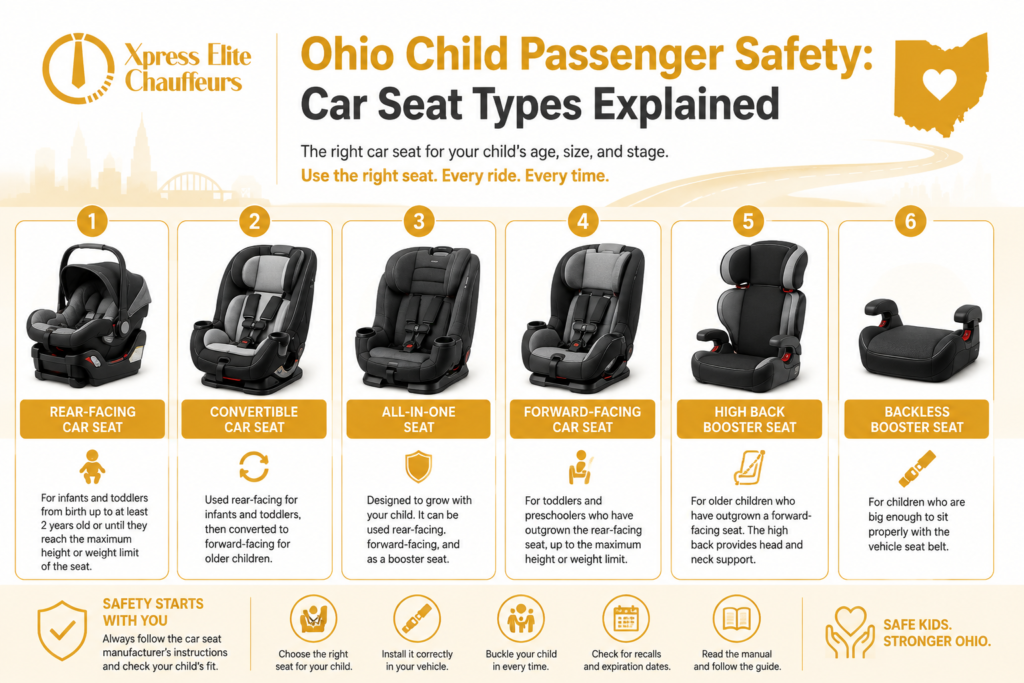
Choosing the right car seat is the foundation of child safety in any vehicle. The main seat categories are: rear facing car seats, forward facing car seats, all in one seats (which cover all stages), and booster seats. The National Highway Traffic Safety Administration provides guidance on each seat type — all car seats sold in the United States must pass federal safety standards under Federal Motor Vehicle Safety Standard 213 — covering passenger cars, light trucks, pickup trucks, and vans.
| Seat type | Age / size range | Weight limits | Key feature |
| Rear facing car seat | Birth to ~2 years+ | Up to 40–50 lbs (varies) | Protects head, neck, spine |
| Convertible car seat | Birth through ~65 lbs | Up to 40–65 lbs forward | Rear and forward facing |
| All-in-one seat | Birth to booster age | Up to 100–120 lbs | Longest use, most versatile |
| Forward facing car seat | 2 years+ (when RF limits reached) | 40–65 lbs typical | 5-point harness |
| High back booster seat | 4 to 8 years / 40–100 lbs | Up to 100–120 lbs | Belt positioning |
| Backless booster seat | Older children / 40+ lbs | Up to 100–110 lbs | Seat belt path guide |
Rear Facing Car Seat
A rear facing car seat is the safest position for infants and toddlers. The rear facing position keeps the child’s head, neck, and spine supported as a single unit during a crash, distributing force across the back of the seat rather than concentrating it on the child’s body. Safety experts recommend extended rear-facing capabilities — NHTSA recommends keeping children rear-facing until they reach the seat’s maximum height and weight limits, not switching to forward facing at the first opportunity.
Children under 1 year must use a rear facing car seat in Ohio. Children between 1 and 4 should remain rear facing if they have not yet reached the seat’s weight limits. For most convertible car seats, the rear facing weight limit is 40 to 50 pounds. Most children can remain rear facing until age 3 or 4 before reaching these limits.
Convertible Car Seat
A convertible car seat can be used in both rear facing and forward facing positions, providing longer use from a single seat. In the rear facing position, the convertible car seat faces the rear of the vehicle. When the child outgrows the rear facing weight limit — typically between 40 and 50 pounds depending on the model — the seat converts to forward facing with a 5-point harness. Use a forward facing seat until the child exceeds the seat’s maximum weight limit, typically between 40 and 65 pounds.
Convertible car seats require careful installation in each position. Always use either the lower anchors (LATCH system) or the vehicle seat belt for installation — not both simultaneously unless the manufacturer specifically allows it. Lower anchors have a maximum weight limit of 65 pounds including the child and seat combined. When lower anchors cannot be used due to weight limits or vehicle configuration, use the vehicle seat belt to install the seat. The car seat should not move more than one inch in any direction when correctly installed.
Forward Facing Car Seat
A forward facing car seat with a 5-point harness is the correct seat when a child has outgrown the rear facing weight or height limits of their convertible car seat. The 5-point harness secures the shoulders, hips, and between the legs with harness straps adjusted to fit snugly, keeping child passengers secure during traffic crashes. Always use a tether with forward facing car seats when a tether anchor is available in the vehicle — this reduces forward movement of the seat in a crash. Check the vehicle owner’s manual for tether anchor location.
Use the forward facing car seat until the child reaches the seat’s maximum weight or height limit. Do not switch to a booster seat before the child is ready — the harness provides significantly more protection than a seat belt alone for younger children. Most children use a forward facing seat between approximately 2 and 7 years old, depending on growth.
Booster Seats: High Back and Backless
Booster seats are required in Ohio for children aged 4 to 7 who are under 4’9″ tall. A booster seat helps the seat belt properly fit the child’s body. A booster seat positions the vehicle’s lap and shoulder belt correctly across the child’s body — the lap belt should lie across the upper thighs and the shoulder seat belts should cross the chest, not the neck. Without a booster seat, the adult seat belt does not fit a child correctly and cannot protect them properly in a crash.
High back booster seats provide head support and side-impact protection features, making them preferable for vehicles without headrests. Backless booster seats are lighter and easier to move between vehicles but require an existing headrest for safe use. Booster seats are needed until children are 4’9″ tall — height, not age, is the determining factor for moving from a booster to an adult seat belt alone.
Installing a Car Seat in a Hired Vehicle: What Parents Need to Know
The LATCH System and Lower Anchors
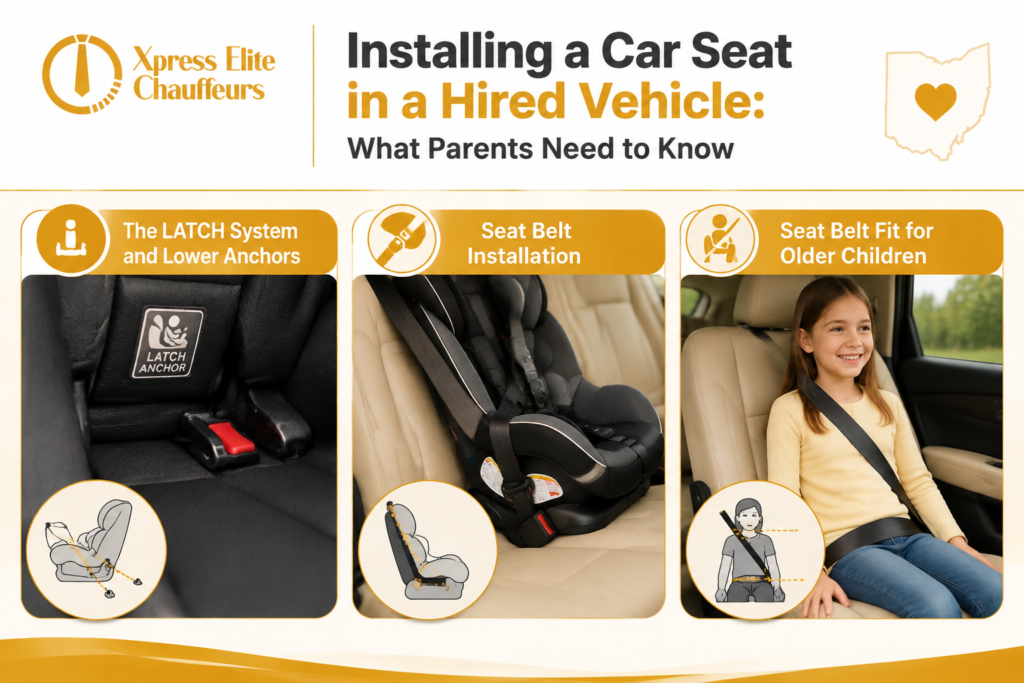
Most passenger vehicles manufactured after 2002 include the LATCH system — lower anchors and tethers for children. Lower anchors are metal bars built into the vehicle seat bight (the crease between the seat back and seat cushion). They allow installation without using the vehicle seat belt. Lower anchors in vehicles are rated for a maximum weight of 65 pounds — this is the combined weight of the child and the car seat. When the combined weight exceeds 65 pounds, use the vehicle seat belt for installation instead.
The latch system makes correct car seat installation more accessible, but does not guarantee correct installation. Installation aids like rigid LATCH connectors and load legs — varying by vehicle manufacturers — minimize installation errors. Check your seat’s manual for which aids are compatible with your vehicle. A certified child passenger safety technician can verify correct installation. In Columbus, Ohio, local resources often provide free car seat inspections and installation assistance — contact Safe Kids Ohio or the Franklin County Health Department for inspection locations.
Seat Belt Installation
If the vehicle does not have accessible lower anchors, or if the combined weight of child and seat exceeds the lower anchor maximum weight limit, install the car seat using the vehicle’s seat belt. Check the vehicle owner’s manual for seat belt locking instructions — some vehicles require the seat belt to be in a locked position for car seat installation. The seat belt must run through the correct belt path marked on the car seat. After installation, the car seat should not move more than one inch side to side or front to back.
In hired vehicles, confirm with the driver that the seat belt locking mechanism functions correctly before installing the seat. Proper seat configuration and seat belts in well-maintained hired vehicles — including our meticulously maintained fleet — are inspected regularly and function per manufacturer specification. If you have any doubt about the vehicle’s seat belt, do not proceed with the trip until the issue is resolved.
Seat Belt Fit for Older Children
When a child no longer requires a booster seat — typically when they reach 4’9″ tall and can sit with their back against the vehicle seat, knees bent comfortably at the edge — they may use the adult seat belt alone. Proper seat belt fit requires the shoulder belt to cross the chest and collarbone, not the neck. The lap belt must lie flat across the upper thighs, not the stomach. If the seat belt does not fit this way, the child still needs a booster seat regardless of age.
Seat belt use reduces the risk of death in traffic crashes by approximately 45 percent for passenger car occupants, according to NHTSA. All children should wear seat belts on every trip, in every vehicle — including hired cars, limos, car services, and aircraft (the Federal Aviation Administration recommends children under 40 pounds use an airplane seat belt or FAA-approved restraint, not a lap belt alone, on flights). Child passenger safety week, held annually in September, is an opportunity for parents and caregivers to have car seat installations inspected by a certified child passenger safety technician.
Air Bags, Front Seats, and Child Passenger Safety
Air bags in passenger vehicles are designed for adult-sized passengers wearing a seat belt. When an air bag deploys in a traffic crash, it expands with significant force — enough to cause serious injury or death to a child passenger sitting in the front seat. The risk is highest for children in rear facing car seats placed in the front seat, where a deploying air bag strikes the back of the seat with direct force toward the child’s head.
All children under 13 should ride in the back seat. This is not a legal requirement under Ohio law but is consistent guidance from the National Highway Traffic Safety Administration, the American Academy of Pediatrics, and every major child passenger safety organization. In a vehicle with two rows, place child passengers in the back seat in the correct facing car seat or booster seat for their age and size. The back seat is consistently safer for children in traffic crashes than the front seat.
If a vehicle has side air bags in the rear seat, position the child’s seat away from the vehicle door to reduce the risk of side air bag impact. Check the vehicle owner’s manual and the car seat manufacturer’s instructions for guidance on positioning near door-mounted air bags. The vehicle’s seat belt and lower anchor positions in the rear seat are designed to work safely with child safety seats and adult occupants together. Never place a rear facing car seat on a rear shelf or parcel shelf — the seat must be secured to the vehicle seat using the correct belt path or lower anchors.
Booking a Limo or Car Service in Columbus, Ohio with Child Passengers
When booking a limo or car service in Columbus, Ohio with child passengers on board, communicate this at the time of booking. This allows us to confirm the vehicle’s seat configuration, rear seat belt type, and available installation points for your specific car seat. Not all vehicles have the same seat belt locking mechanisms or lower anchor positions — knowing your car seat type and the child’s age and weight helps us confirm the right vehicle before your trip.
We provide child-safe ground transportation across Columbus, Ohio, and Central Ohio. Our drivers allow time for correct car seat installation before departure, do not rush the process, and can advise on vehicle seat belt access if needed. We do not provide car seats — consistent with the professional standard for hired vehicles — but we support parents who bring their own and install correctly. Every vehicle in our fleet is meticulously maintained, with seat belts inspected and confirmed functional on each service.
For group transportation with families and children, contact us at 614-254-9008 or visit xectransport.com. Share your group size, the number and ages of child passengers, and the car seat types you will be bringing — and we will confirm the right vehicle configuration and pick up logistics for a safe, stress-free trip.
Frequently Asked Questions: Car Seats, Ohio Law, and Limo Services
Are limo services required to provide car seats for child passengers in Ohio?
No. Ohio law places responsibility for providing and installing a child safety seat on the parent or guardian, not the vehicle operator. Most limo and car services do not supply car seats. Always bring your own seat — inspected, not previously in a crash, and not past its expiration date. Call 614-254-9008 before booking to confirm vehicle seat belt access for installation.
What does Ohio law require for rear facing car seats?
Ohio law (ORC 4511.81) requires a child safety seat for children under 4 years or under 40 pounds in all passenger vehicles. NHTSA recommends a rear facing seat for as long as possible — until the seat’s maximum weight or height limits are reached. Children under 1 must use a rear facing car seat, which spreads crash force across the seat back.
How do I install a forward facing car seat in a hired vehicle?
Install a forward facing car seat using the lower anchors or the seat belt — not both unless the manufacturer allows it. Lower anchors have a 65-pound combined weight limit. Always use a tether when available. The seat must not move more than one inch. A certified child passenger safety technician can inspect the installation at no cost in Columbus, Ohio.
When can a child in Ohio stop using a convertible car seat and switch to a booster?
A child outgrows a convertible car seat when they exceed its maximum weight or height limit — typically 40 to 65 pounds forward facing. Ohio law requires a booster seat for children aged 4 to 7 who are under 4’9″ tall. Do not switch to a booster until the child has genuinely outgrown the convertible seat’s harness limits. The 5-point harness on a forward facing seat provides significantly more protection in traffic crashes than a booster seat with a vehicle seat belt alone.
Are children safe with just a seat belt if they keep the forward facing car seat at home?
No — a seat belt alone does not fit a child’s body correctly until they are approximately 4’9″ tall and can sit with their back flat against the seat. Without a booster seat, proper seat belt positioning is impossible — the lap belt sits on the stomach rather than the upper thighs, and the shoulder belt crosses the neck instead of the chest. Both positions significantly increase the risk of serious injury in traffic crashes. Children should remain in the correct child safety seat or booster seat until the adult seat belt fits their body correctly.
Where can parents in Columbus, Ohio get car seat installation help?
Parents in Columbus, Ohio can get free car seat inspections from certified technicians at Safe Kids Franklin County or Ohio State University Wexner Medical Center. Use NHTSA’s technician locator at nhtsa.gov. Child Passenger Safety Week each September offers free events across Central Ohio.
What to Tell Your Limo Service When Booking with Child Passengers
When booking a limo or car service in Columbus, Ohio with child passengers, provide the following information at the time of reservation to ensure a safe and smooth trip for your group:
• Number of child passengers and their ages — this helps confirm seat count and vehicle type
• Car seat types you will be bringing — rear facing car seat, convertible car seat, forward facing car seat, or high back booster seats
• Child’s weight and height — confirms whether the seat belt is appropriate or a car seat is still required under Ohio law
• Whether the seat uses the LATCH system or seat belt installation — vehicle seat belt locking mechanisms vary, and confirming in advance avoids installation issues at pick up
• Any additional stops — relevant if child passengers will be boarding or exiting at multiple locations
A responsible operator will confirm the vehicle’s rear seat configuration, seat belt type, and lower anchor availability. When choosing a car seat, NHTSA ease of use ratings help parents identify models that install correctly across different vehicle types. At Xpress Elite Chauffeurs, we ask parents these questions during the booking process so there are no surprises on the day. The child correctly installed in the right car seat, in a meticulously maintained vehicle with a professional driver, is the standard we provide on every family trip across Columbus, Ohio and Central Ohio.
Book a Child-Safe Limo or Car Service in Columbus, Ohio
Traveling with children requires the right vehicle, the right seat, and a driver who allows time for correct installation. Xpress Elite Chauffeurs provides professional ground transportation across Columbus, Ohio, and Central Ohio — with meticulously maintained vehicles, experienced drivers, and a booking process that accommodates families with child passengers.
We do not supply car seats — bring your own, correctly sized for your child’s age and weight. We provide the vehicle, the seat belt access, and the time to install safely before departure. Call 614-254-9008 or visit xectransport.com for a free quote. Share your group size, child passenger ages, and car seat requirements — and we will confirm the right vehicle for your trip.
Xpress Elite Chauffeurs | 614-254-9008 | xectransport.com | 81 Mill St Suite 300, Gahanna, OH 43230